
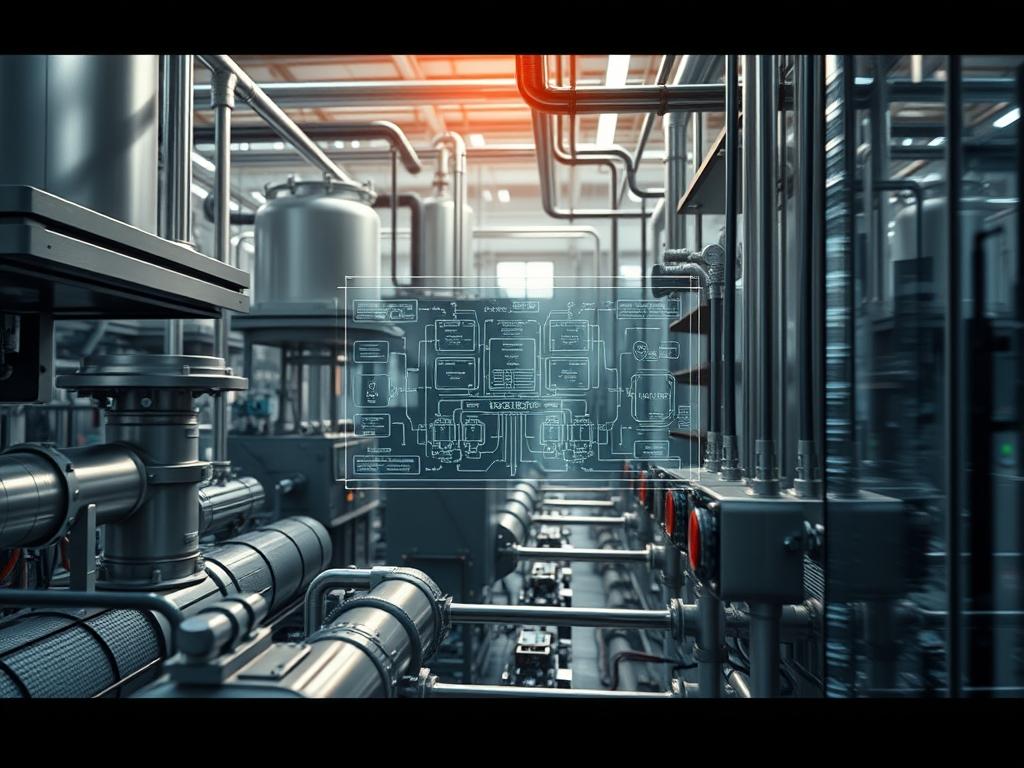
Microfiltration System Engineering represents the critical interface between physical fluid dynamics and logic-controlled infrastructure management. In the context of modern technical stacks; specifically high-density liquid cooling for data centers and industrial energy circuits; the exclusion of coarse particles is mandatory to prevent mechanical degradation. Particulate contamination introduces systemic risks such as localized thermal-inertia within heat exchangers and physical erosion of sensitive valve seats. Microfiltration System Engineering addresses these risks by deploying membrane-based separation layers that operate at the micron scale. The objective is to achieve a steady-state fluid purity level that minimizes maintenance overhead while maximizing the throughput of the thermal transport medium. By integrating advanced sensors and logic controllers, architects can transform a passive mechanical filter into an active, data-driven component of the facility operations. This system serves as a defensive layer; ensuring that the fluid payload remains free of abrasives that would otherwise lead to signal-attenuation or physical hardware failure in the cooling loop.
Technical Specifications
| Requirement | Operating Range | Protocol/Standard | Impact Level | Resources |
| :— | :— | :— | :— | :— |
| Particle Size Exclusion | 0.1 to 10.0 Microns | ISO 12103-1 | 10 | 316L Stainless Steel |
| Transmembrane Pressure (TMP) | 0.5 to 3.0 Bar | ANSI/ASME B31.3 | 8 | High-Torque Actuators |
| Logic Controller Throughput | 100 Mbps Ethernet | Modbus TCP/IP | 7 | 2GB RAM / 4-Core CPU |
| Transducer Signal Range | 4-20 mA | IEC 60381-1 | 9 | Shielded Twisted Pair |
| Chemical Compatibility | pH 2.0 to 12.0 | ASTM D1293 | 6 | PVDF or PES Membranes |
| Ingress Protection | IP67 / NEMA 4X | IEC 60529 | 8 | Powder-Coated Steel |
Configuration Protocol
Environment Prerequisites:
Successful deployment of Microfiltration System Engineering requires strict adherence to both physical and digital prerequisites. The infrastructure must comply with NEC Article 430 for motor controllers and NFPA 70 for electrical safety. On the control layer; the system requires a Linux-based gateway (Ubuntu 22.04 LTS or RHEL 9 recommended) with Python 3.10+ and the pymodbus library installed. User permissions must be configured via sudoer groups to allow access to serial ports and network sockets. Hardware dependencies include a FLUKE-789 ProcessMeter for loop calibration and a Logic-Controller (PLC) with at least 16-bit analog-to-digital resolution for precise pressure differential monitoring.
Section A: Implementation Logic:
The engineering design is predicated on the principle of flux maintenance through automated backwashing. Unlike static filters; microfiltration systems utilize a dynamic control loop where the pressure differential (delta-P) between the inlet and outlet dictates the operational state. When the logic controller detects a rise in delta-P; it identifies an accumulation of coarse particles on the membrane surface. The system must then execute an idempotent backwash sequence; reversing the flow to dislodge contaminants without human intervention. This setup ensures that the system maintains high throughput while minimizing the energy overhead required to pump fluid through a fouled medium. Encapsulation of sensor data into Modbus packets allows the central management suite to monitor the health of the filter array in real-time; correlating pressure spikes with external events like pump surges or chemical dosing.
Step-By-Step Execution
1. Physical Manifold Assembly
Assemble the microfiltration housing ensuring that the 316L Stainless Steel chassis is grounded to the common facility earth. Install the Pressure Transducers on the upstream and downstream ports of the filter housing using PTFE thread sealant.
System Note: Precise physical orientation of the transducers is required to prevent air pocket formation; which causes signal-attenuation and erratic logic-controller readings in the primary feedback loop.
2. Network Gateway Initialization
Boot the controller and update the system repositories using apt-get update. Install the necessary communication drivers and identify the hardware interface for the PLC using ls /dev/tty* or ip addr show.
System Note: This step establishes the digital bridge; the kernel must recognize the network interface card (NIC) to allow the flow of telemetry from the physical asset to the monitoring stack.
3. Controller Logic Deployment
Navigate to the configuration directory at /etc/mfs/logic/ and create the primary control script filter_ctrl.py. Define the threshold variables for the backwash trigger; typically set at 1.5 times the baseline clean-filter pressure.
System Note: Modifying scripts at the kernel level requires chmod +x permissions; this script manages the concurrency of the valve timing to ensure no two valves open simultaneously and cause hydraulic shock.
4. Transducer Calibration via Fluke-Multimeter
Connect the FLUKE-789 ProcessMeter to the 4-20 mA loop. Force the PLC to output a 4 mA signal and verify that the physical valve is at 0% position. Repeat the process for 20 mA at 100% position to ensure a linear response.
System Note: Incorrect calibration leads to latency in system response; potentially allowing the transmembrane pressure to exceed the physical burst rating of the PES Membrane.
5. Daemon Activation and Persistence
Enable the microfiltration control service using systemctl enable mfs_logic.service and start the process with systemctl start mfs_logic.service. Monitor the initial startup logs via journalctl -u mfs_logic.service -f.
System Note: Setting the service to enable ensures that the microfiltration logic persists across system reboots; maintaining the idempotent state of the hardware regardless of power fluctuations.
Section B: Dependency Fault-Lines:
Microfiltration System Engineering is susceptible to various mechanical and digital bottlenecks. A common physical bottleneck is the thermal-inertia of concentrated cleaning chemicals during a Clean-In-Place (CIP) cycle; if the temperature remains too low; the flux recovery will be incomplete. Digitally; library conflicts between OpenSSL and legacy Modbus drivers can stop the telemetry stream; resulting in a “Blind System” state where the filter may bypass or clog without triggering an alarm. Furthermore; high packet-loss on the local subnet can result in delayed command execution for the backwash valves; causing a significant pressure spike that stresses the pump seals.
THE TROUBLESHOOTING MATRIX
Section C: Logs & Debugging:
When a fault occurs; the engineer should immediately inspect the log file located at /var/log/mfs/error.log. Common error strings and their physical counterparts include:
– ERR_TMP_HIGH: Indicates the transmembrane pressure has exceeded the 3.0 Bar limit. Action: check for membrane “scaling” or valve failure in the backwash circuit.
– SIGNAL_TIMEOUT_0x04: Represents a loss of communication with the downstream transducer. Action: inspect the Shielded Twisted Pair cabling for physical breaks or electromagnetic interference.
– VALVE_ASYNC_ERROR: Occurs when the limit switch on a valve fails to report back within 500ms of a command. Action: use the Logic-Controller override to manually cycle the actuator and check for mechanical resistance.
– IO_LATENCY_CRIT: Suggests the CPU is overloaded and cannot process the PID loop at the required frequency. Action: check for rogue processes using top or htop and optimize the telemetry polling rate.
OPTIMIZATION & HARDENING
Performance Tuning
To increase throughput and reduce the overhead of the filtration process; implement a “Lead-Lag” configuration if multiple filter arrays are present. This allows for horizontal scaling of the fluid volume processed. By staggering the backwash cycles of individual units; the system maintains a constant flow rate to the primary payload; such as a data center cooling loop; preventing pressure drops that could trigger a pump-down. Additionally; tuning the PID coefficients (Proportional, Integral, Derivative) in the controller software reduces the “hunting” behavior of the control valves; leading to smoother pressure transitions and lower mechanical wear.
Security Hardening
Firmware and software security are paramount in Microfiltration System Engineering. Ensure that the PLC is isolated on a dedicated Management VLAN with no direct internet access. Use iptables or nftables on the gateway to restrict traffic to known MAC addresses of the engineering workstations. Disable any unused services such as Telnet or HTTP on the logic-controllers in favor of encrypted protocols like SSH or HTTPS. Physical logic-hardening includes the installation of “Fail-Closed” pneumatic actuators; if power is lost; the system automatically seals the inlet to prevent unfiltered fluid from entering the downstream infrastructure.
Scaling Logic
As the demand on the facility grows; the Microfiltration System must scale proportionally. The modular design of the manifold allows for the addition of “Filter Skids” in parallel. When adding a new skid; the central controller must be updated with the new node IP and the load-balancing logic must be recalculated to prevent overloading the primary feed pump. In cloud-based infrastructure; the use of a “Digital Twin” can assist in predicting when additional filtration capacity will be required based on trending data of particulate ingestion.
THE ADMIN DESK
What is the most common cause of membrane failure?
Excessive transmembrane pressure (TMP) caused by delayed backwash cycles is the leading cause. This typically results from a logic-controller failure or a miscalibrated pressure transducer that permits the system to operate beyond its physical design limits.
How is signal-attenuation managed in long sensor runs?
Use 4-20 mA current loops instead of voltage-based signals to minimize the impact of cable resistance. Ensure all signal wires are contained within a dedicated; grounded conduit and keep them separated from high-voltage motor power leads.
Can the system handle oily particulates effectively?
Coarse particle microfiltration is primarily designed for solids. Oily contaminants require an automated “Chemical Wash” cycle or a pre-treatment oil-water separator to prevent irreversible fouling of the membrane pores; which results in a permanent loss of throughput.
How does the system handle a total power loss?
The engineering design utilizes “Fail-Safe” logic where all critical valves return to a predetermined state (usually closed) via mechanical springs. This ensures the integrity of the downstream payload is maintained until the logic-controller can reboot and resynchronize.
What is the recommended interval for sensor recalibration?
Sensors should be verified every six months using a certified reference gauge like a FLUKE-789. However; if the logs show frequent SIGNAL_TIMEOUT or ERR_TMP_HIGH warnings; an immediate calibration check of the entire loop is mandatory.