
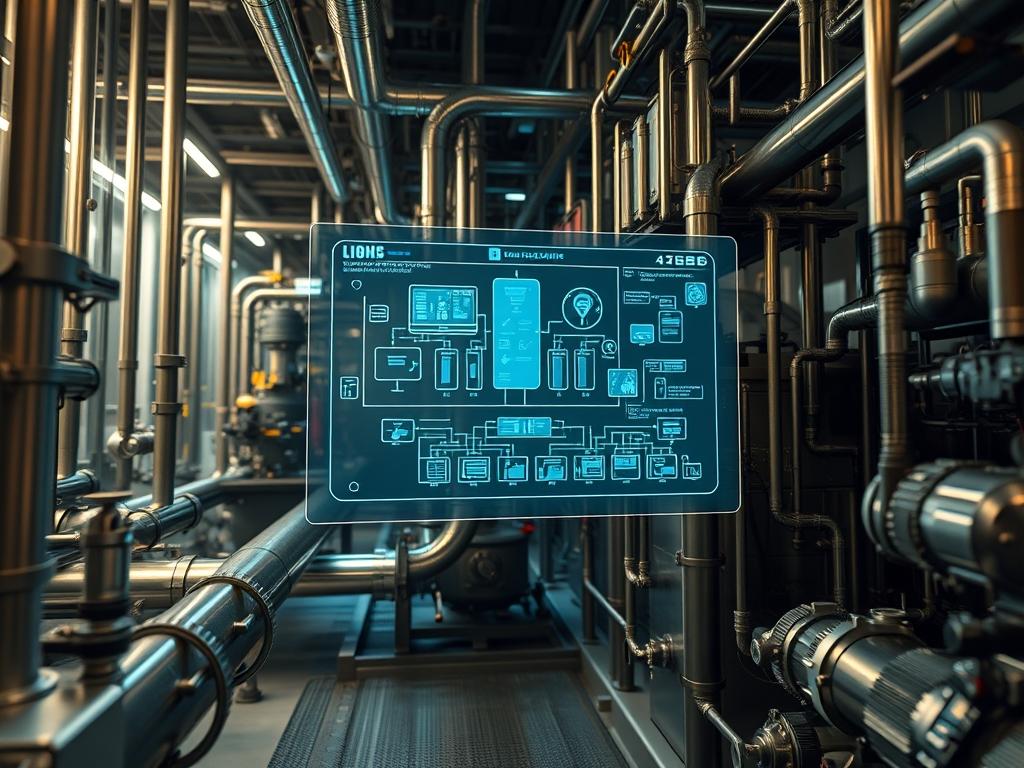
Membrane Distillation Principles function by leveraging a non-isothermal phase change across a microporous hydrophobic barrier. This process operates at the intersection of thermal energy management and hydraulic throughput; it is a thermally driven separation technology where the “driving force” is the partial vapor pressure gradient across the membrane. Unlike Reverse Osmosis (RO), which relies on extreme mechanical pressure to overcome osmotic tension, membrane distillation utilizes the volatility of water molecules at elevated temperatures. This mechanism allows the system to process hypersaline brines that would normally trigger technical failure or efficiency loss in pressure-driven systems. In modern industrial infrastructure, these principles are integrated into co-generation plants or remote sensor networks where waste heat is abundant. The solution addresses the “energy-water nexus” by converting low-grade thermal payloads into high-purity distillate. By decoupling the separation process from hydraulic pressure, the system reduces mechanical stress on the membrane housing and minimizes the risk of irreversible fouling in the technical stack.
TECHNICAL SPECIFICATIONS
| Requirement | Default Port / Operating Range | Protocol / Standard | Impact Level (1-10) | Recommended Resources |
| :— | :— | :— | :— | :— |
| Feed Temperature | 60C to 90C | ISO 15605 | 9 | High Thermal Output |
| Pore Size | 0.1 to 0.45 microns | ASTM D6767 | 7 | PTFE/PVDF Membrane |
| Monitoring Port | Port 502 (Modbus/TCP) | IEEE 802.3 | 6 | 8GB RAM / Quad-Core |
| Hydrophobicity | > 120 degrees (LEP) | ASTM D5946 | 10 | Fluoropolymer Coating |
| Flow Velocity | 0.5 to 2.5 m/s | ANSI/ISA-7.0.01 | 8 | Variable Freq Drive |
THE CONFIGURATION PROTOCOL
Environment Prerequisites:
1. Standards Compliance: All electrical installations must adhere to NEC Article 430 for motor controls and IEEE 802.3 for network-based sensor telemetry.
2. Hardware: A hydrophobic membrane module (PTFE, PVDF, or PP) with a minimum Liquid Entry Pressure (LEP) of 2.5 bar.
3. Software: Access to the Logic Controller firmware via root or administrator-level credentials is required to modify thermal setpoints.
4. Physical: A dual-loop heat exchange system capable of maintaining a 20C to 40C temperature delta between the feed and permeate channels.
Section A: Implementation Logic:
The engineering design of Membrane Distillation Principles rests on the gas-liquid interface stability within the membrane pores. Because the membrane is hydrophobic, the liquid feed cannot penetrate the dry pores unless the Liquid Entry Pressure is exceeded. This creates an encapsulation of the vapor phase. When a temperature gradient is applied, water evaporates at the hot interface, migrates through the pore as a gas payload, and condenses on the cold side. The idempotent nature of the phase change ensures that only volatile components cross the barrier; non-volatile salts and contaminants are rejected with nearly 100 percent efficiency. The thermal-inertia of the system must be carefully managed to prevent “temperature polarization,” where the boundary layer temperature drops, reducing the vapor pressure driving force and damaging overall throughput.
Step-By-Step Execution
1. Initialize Thermal Loop and Feed System
Execute a pre-start check on the thermal delivery network using systemctl start md-thermal-control.service. System Note: This command initializes the PID (Proportional-Integral-Derivative) loop within the logic-controllers, bringing the feed tank to a baseline temperature of 60C. Use a fluke-multimeter to verify that the heating element resistance is within the manufacturer’s specified Ohmic range.
2. Configure Hydraulic Flow Velocity
Adjust the Variable Frequency Drive (VFD) to achieve a Reynolds number greater than 2500 in the feed channel. System Note: Increasing turbulence at the membrane surface reduces the boundary layer thickness. This minimizes signal-attenuation of the thermal gradient and mitigates chemical scaling. Use the command vfd-control –set-freq 45Hz to stabilize the flow.
3. Establish Transmembrane Pressure Delta
Calibrate the permeate side pressure. For Vacuum Membrane Distillation (VMD), use chmod +x vacuum_pump_start.sh followed by the execution script to lower the absolute pressure on the dry side of the membrane. System Note: Lowering the permeate-side pressure increases the throughput by widening the vapor pressure gap, but it must remain above the point where the membrane structure collapses under mechanical stress.
4. Engage Real-time Flux and Conductivity Monitoring
Monitor the distillate quality by piping sensor data to a logging utility: tail -f /var/log/md_system/conductivity.log. System Note: A sudden spike in conductivity indicates “pore wetting,” a critical failure where the liquid feed breaches the hydrophobic barrier. This usually requires an immediate systemctl stop md-feed-pump.service to prevent contamination of the entire distillate reservoir.
Section B: Dependency Fault-Lines:
1. Thermal Polarization: High latency in heat transfer from the bulk fluid to the membrane surface reduces the effective driving force.
2. Pore Wetting: If the surface tension of the feed is lowered by surfactants, the liquid will bypass the encapsulation barrier, resulting in total packet-loss of separation integrity.
3. Scaling: Calcium carbonate or sulfate precipitation on the membrane surface increases the overhead energy required to maintain flux and can lead to permanent flux decline.
THE TROUBLESHOOTING MATRIX
Section C: Logs & Debugging:
The primary diagnostic tool for Membrane Distillation Principles is the correlation between thermal input and permeate flux. Log files located at /var/log/md_system/analytics.json should be parsed for “Flux-to-DeltaT” ratios.
– Error Code WET-01: “Conductivity Threshold Exceeded.” This signifies liquid penetration into the membrane pores. Check the fluke-multimeter readings on the leak detection sensors located at the module’s permeate outlet.
– Error Code PRE-05: “Differential Pressure Warning.” This suggests a blockage in the feed spacers. Verify via the logic-controllers that the pressure drop across the module does not exceed 1.5 bar.
– Visual Cues: Air bubbles in the permeate line often indicate a breach in the vacuum seal or membrane rupture. If the distillate appears turbid, the hydrophobicity has been compromised; perform a chmod 600 config.yaml and update the “Membrane-Health” parameter to trigger a maintenance lockout.
OPTIMIZATION & HARDENING
Performance Tuning:
To maximize throughput, implement a “Multi-Stage” MD configuration where the latent heat of condensation from the first stage is recycled to heat the feed of the second stage. This reduces the specific thermal energy consumption. Adjust the concurrency of the fluid streams to ensure that the temperature delta remains consistent across all modules in the rack. Tuning the PID parameters can reduce latency in thermal response during startup.
Security Hardening:
The logic-controllers managing the thermal valves and pumps must be isolated from the public internet using a robust firewall. Use iptables -A INPUT -p tcp –dport 502 -s [admin_ip] -j ACCEPT to restrict Modbus access to authorized workstations only. Physically, the system must include fail-safe mechanical valves that close upon loss of power to prevent boiling liquid from entering the permeate tanks.
Scaling Logic:
Expansion of Membrane Distillation Principles involves a modular “Scale-Out” approach rather than “Scale-Up.” Instead of larger individual membranes, add identical membrane modules in parallel. This maintains the same hydraulic characteristics and thermal-inertia profiles across the infrastructure. Use a centralized load balancer to distribute the feed brine across the module array, ensuring that no single unit exceeds its rated throughput capacity.
THE ADMIN DESK
How do I recover a wetted membrane?
Stop the feed flow immediately. Flush the module with deionized water, then pass dry, heated air through the pores for 24 hours. Verify the recovery of hydrophobicity by measuring the Liquid Entry Pressure with a fluke-multimeter pressure transducer.
What causes a sudden drop in distillate flux?
Potential causes include temperature polarization, membrane scaling, or internal packet-loss of vapor due to trapped air. Check the heat exchanger for fouling and verify that the feed pump is maintaining the correct Reynolds number for turbulent flow.
Can MD handle oil-contaminated water?
Standard PTFE membranes will foul or wet in the presence of oils. Pre-treatment is required to remove organic payloads, or an omniphobic membrane coating must be applied to prevent the oil from lowering the surface tension at the pore interface.
Is the energy consumption higher than RO?
Yes; MD is a phase-change process and inherently consumes more energy per liter. However, its value lies in using “zero-cost” waste heat or processing high-salinity yields where RO latency and osmotic pressure limits make it technically unfeasible.
How often should the sensors be recalibrated?
Sensors for conductivity and temperature should be calibrated every 90 days. Use NIST-traceable standards to ensure the logic-controllers are receiving accurate telemetry; small deviations in temperature readings significantly impact the calculated vapor pressure driving force.