
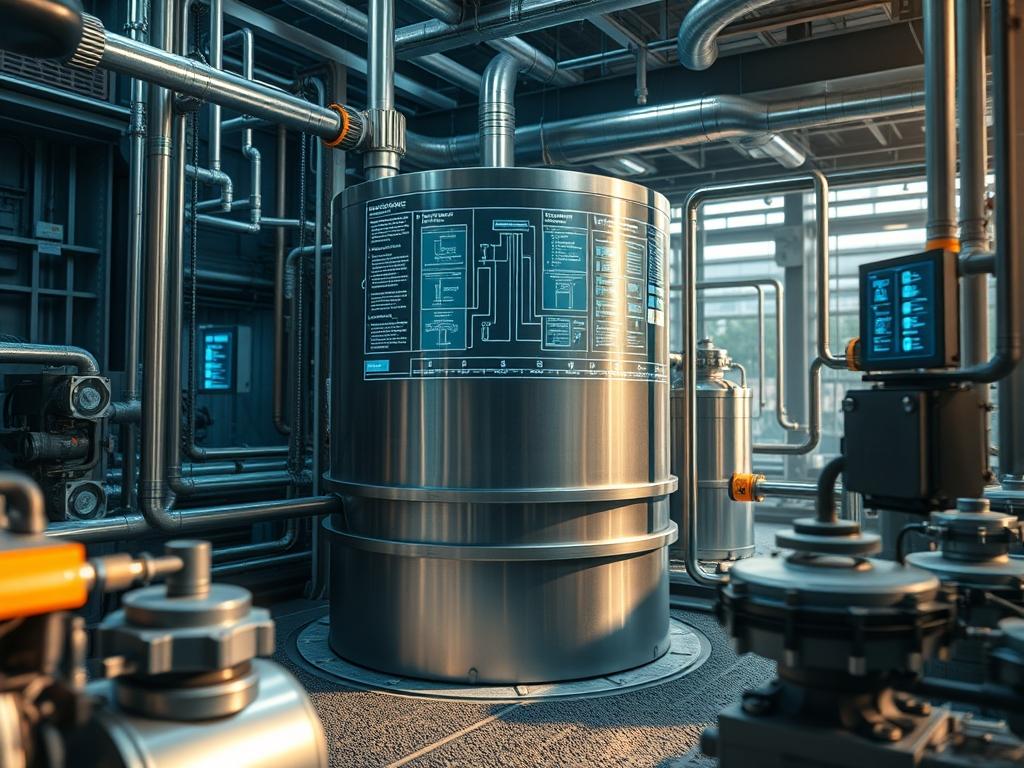
Effective management of onsite water recycling necessitates the strategic implementation of Sizing Greywater Surge Tanks to mediate the discrepancy between supply generation and treatment throughput. In high-density commercial or residential infrastructure; the instantaneous discharge of greywater from showers; sinks; and laundry facilities often exceeds the processing capacity of the downstream bioreactors or filtration skips. This discrepancy creates a requirement for a hydraulic buffer; or surge tank; which accumulates raw influent during peak usage periods and distributes it to the treatment system at a constant; manageable flow rate. Without precise sizing; the system faces two primary failure modes: hydraulic overload leading to untreated bypass events or excessive stagnation leading to anaerobic decomposition and subsequent odor complaints. The sizing methodology integrates fluid dynamics; occupancy patterns; and treatment kinetics to ensure the system maintains a state of equilibrium. Within the broader technical stack of sustainable building automation; the surge tank serves as the physical layer of the water management load balancer; providing the necessary latency between harvest and reuse.
Technical Specifications
| Requirement | Default Port/Operating Range | Protocol/Standard | Impact Level (1-10) | Recommended Resources |
| :— | :— | :— | :— | :— |
| Influent Capture | 25 to 5,000+ GPD | NSF/ANSI 350 | 9 | Reinforced Polyethylene or 304 SS |
| Level Monitoring | 4-20mA / 0-10V | Modbus RTU / BACnet | 8 | Ultrasonic or Hydrostatic Sensors |
| Pump Control | 60 Hz / 230V AC | PWM / VFD Control | 7 | PLC with 2GB RAM / Industrial CPU |
| Overflow Logic | Gravity Driven | IPC Section 710 | 10 | Air Gap / Backwater Valve |
| Tank Venting | 2 to 4 inch diameter | ASPE Data Book | 6 | Activated Carbon Filtration |
The Configuration Protocol
Environment Prerequisites:
System architects must ensure compliance with local plumbing codes; such as the International Plumbing Code (IPC) or the Uniform Plumbing Code (UPC); prior to final vessel selection. Hardware dependencies include a NEMA 4X rated control enclosure for the logic controllers and a high-resolution level sensor with an accuracy of plus or minus 0.25 percent of the total span. Software prerequisites for calculated modeling include a building information modeling (BIM) suite or custom Python-based scripts utilizing the NumPy library for high-speed computation of diurnal flow datasets. User permissions must be elevated to Level 3: Infrastructure Administrator to modify the setpoints on the Building Management System (BMS) head-end.
Section A: Implementation Logic:
The engineering design of a surge tank relies on the principle of hydraulic attenuation. The objective is to convert a variable; high-amplitude input signal (the residential shower rush) into a low-amplitude; long-duration output signal (the treatment flow rate). The core logic follows the formula: V_surge = (Q_peak – Q_treat) * T_duration; where V_surge represents the required volume; Q_peak is the average peak inflow rate; Q_treat is the treatment system’s throughput; and T_duration is the length of the peak period. By decoupling the collection rate from the treatment rate; we maximize the ROI of the treatment hardware by allowing it to run at a continuous; steady state rather than sizing it for the absolute maximum peak; which would result in significant idle time and hardware overhead.
Step-By-Step Execution
1. Quantification of Daily Greywater Potential (DGP)
Calculate the total daily volume of water available for capture by summing all contributing fixtures. Use the Drain_Fixture_Unit (DFU) values from the IPC_Table_709.1 to estimate potential flow. Multiply the number of occupants by the average GPC (Gallons Per Capita) specific to the building type.
System Note: This calculation establishes the upper bound for the Input_Payload in the system’s memory register; ensuring that the physical vessel can accommodate at least 50 percent of the daily volume if the treatment system undergoes a scheduled maintenance blackout.
2. Establishment of the Diurnal Flow Curve
Map the occupancy patterns in 15-minute increments to identify the Peak_Hour_Factor. In typical residential environments; 70 percent of total daily volume is generated during two distinct 2-hour windows (morning and evening). Assign these variables to the Time_Series_Array within the controller.
System Note: The BMS_Kernel utilizes this data to anticipate high-load events; allowing the system to pre-empty the tank to its Dead_Volume level before the peak window begins; effectively increasing available head-room.
3. Definition of Treatment Throughput (Q_Treatment)
Analyze the maximum flow rate of the greywater treatment system. This is typically limited by the Flux_Rate of the membrane bioreactor (MBR) or the Saturation_Point of the media filter. This value must be entered as a constant in the Flow_Control_Algorithm.
System Note: This variable dictates the Duty_Cycle of the discharge pumps. If Q_Treatment is too high; the filter layers may undergo mechanical stress or scouring; if too low; the surge tank will require a much larger footprint to prevent overflow.
4. Direct Calculation of Surge Volume
Apply the mass balance equation to find the storage requirements. Subtract the volume treated during the peak window from the volume generated during the peak window. For example; if 400 gallons are produced over 2 hours and the treatment system processes 50 gallons per hour; the surge requirement is 300 gallons.
System Note: The Logic_Controller monitors the Current_Liquid_Level via an Ultrasonic_Sensor. If the calculated surge exceeds the High_Level_Alarm setpoint; the controller triggers a Sanitary_Bypass_Relay to divert excess water.
5. Integration of Dead Volume and Freeboard
Add an additional 10 percent volume to the bottom of the tank to prevent pump cavitation (Dead Volume) and 10 to 15 percent at the top to prevent sensor splashing and provide an air gap (Freeboard). Ensure the Total_Vessel_Capacity accounts for these non-usable zones.
System Note: Proper configuration of Dead_Volume prevents air from entering the treatment skid; which would otherwise cause Pump_Air_Lock or damage sensitive biological films within the treatment reactor.
Section B: Dependency Fault-Lines:
The most frequent failure in Sizing Greywater Surge Tanks is the underestimation of “Simultaneous Use” factors in multi-family dwellings. If the Concurrency_Coefficient is ignored; the surge tank will reach capacity within minutes of a peak event. Another bottleneck is the accumulation of solids; or sludge-blanket formation. If the tank is oversized; the idempotent velocity of the water drops too low; causing suspended solids to settle and ferment. This creates a biological oxygen demand (BOD) spike that can overtax the treatment system’s oxidation capacity. Lastly; sensor fouling from hair and soap scum can create “Ghost Echoes” in ultrasonic sensors; leading to false readings and improper pump activation.
THE TROUBLESHOOTING MATRIX
Section C: Logs & Debugging:
When diagnosing issues; the administrator should first check the PLC_Error_Log for Signal_Attenuation flags. Low signal strength on the level sensor typically indicates condensation on the sensor face or foam buildup on the water surface.
| Symptom | Probable Cause | Action Path |
| :— | :— | :— |
| Error Code E04: High Level | Discharge Pump Failure | Verify Contactor_K1 status and check pump Amperage_Draw. |
| Rapid Pump Cycling | Minimal Hysteresis | Increase Low_Level_Cutoff and High_Level_Start differential. |
| Odor at Vent | Anaerobic Conditions | Check Retention_Time_Log; reduce tank volume or increase aeration. |
| Inaccurate Volume | Sensor Scaling Error | Recalibrate 4-20mA loop using known distance measurements. |
Inspect physical logs at /var/log/water_systems/surge_control.log for historical flow data. Look for timestamps where Inflow_Rate significantly exceeded Outflow_Rate without a corresponding increase in tank level; as this indicates a leak or a faulty bypass valve.
OPTIMIZATION & HARDENING
Performance tuning involves the implementation of a Variable Frequency Drive (VFD) on the transfer pumps. Instead of a simple “On/Off” logic; the VFD adjusts the Throughput based on the current tank level; ensuring a steady flow to the treatment system that maximizes membrane life. This reduces the Thermal_Inertia of the motors and lowers peak electrical demand.
Security hardening focuses on the physical-digital interface. Ensure that all Overflow_Weirs are mechanically sized to handle the maximum possible influent pipe capacity via gravity; independent of any electrical logic. This is an idempotent failsafe. Digitally; restrict the Modbus gateway to a managed VLAN with a strict firewall policy; allowing only the building’s central SCADA system to read data. This prevents unauthorized tampering with tank setpoints that could result in intentional flooding.
Scaling logic for future expansion should utilize modular; parallel tank configurations. Use the Master-Slave architecture for level sensing: the primary tank contains the Control_Sensor; while secondary tanks are connected via a large-diameter Equalization_Line. This allows the capacity to be increased by 200 to 500 percent without requiring a complete rewrite of the PLC_Logic_Core.
THE ADMIN DESK
How frequent should sensor maintenance occur?
Level sensors should be inspected every 90 days. Wipe the transducer face with an isopropyl alcohol solution to remove bio-film. Verify that the Modbus_Registers match the physical depth measured by a manual tape to ensure calibration accuracy.
What is the maximum allowed retention time?
Ideally; greywater should not remain in a surge tank for more than 24 hours. Prolonged storage increases the Biological_Oxygen_Demand (BOD) and leads to septic conditions. If the residence time exceeds this; the system should trigger an auto-drain.
Can I use a single-speed pump for discharge?
While possible; it is not recommended. Single-speed pumps create high-velocity surges that can disrupt the biological processes in the treatment unit. A VFD or a flow-control valve is essential for maintaining constant treatment Throughput.
What happens during a power failure?
The system must be configured for a “Fail-Closed” state on the influent valve and a “Fail-Open” state for the gravity bypass. This ensures that during a power loss; greywater is safely diverted to the sewer rather than flooding the facility.
How is foam buildup managed?
Install a High_Level_Float as a mechanical backup to the ultrasonic sensor. If foam causes false readings; an anti-foaming agent can be dosed; or the tank can be equipped with a spray-nozzle cycle to knock down the foam head.