
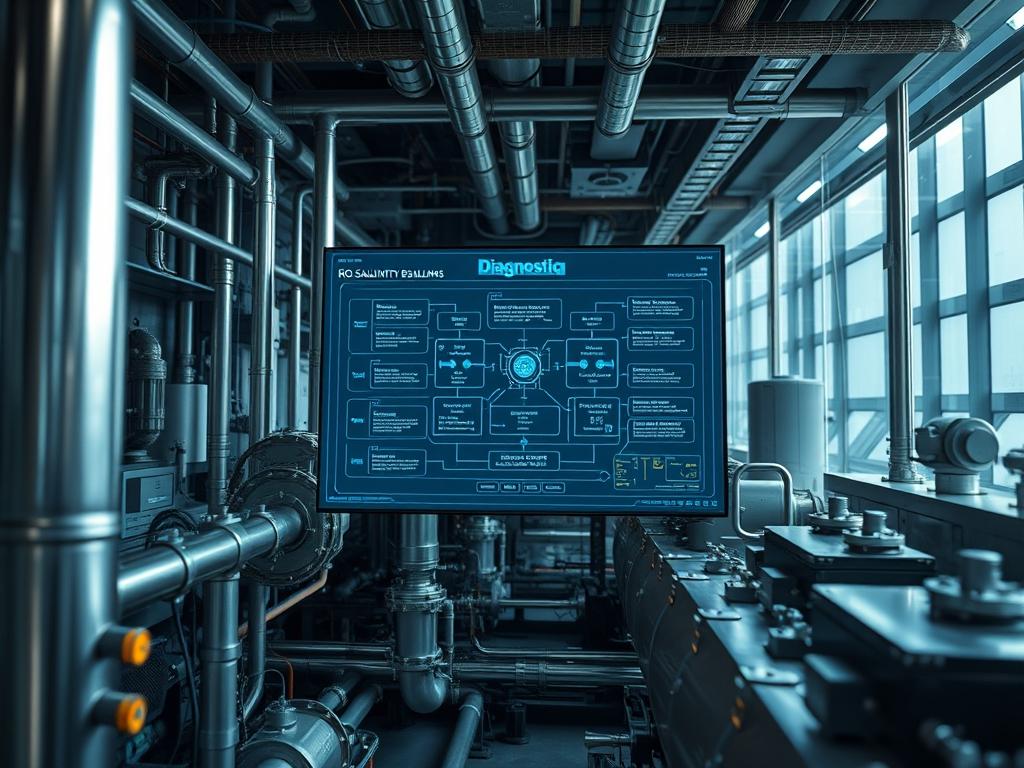
Engineering large scale RO High Salinity Desalination systems requires a sophisticated integration of high pressure hydraulics, advanced material science, and real time industrial control systems. Within the modern technical stack, RO High Salinity Desalination serves as the critical water production layer for municipal grids, industrial cooling loops, and green hydrogen electrolyzer feeds. The primary problem addressed is the thermodynamic barrier of osmotic pressure; as salinity levels in the feed water increase, the energy required to overcome the natural flow of solvent into the solute rises exponentially. Conventional desalination setups often fail under the corrosive load and mechanical stress of hypersaline environments. By implementing a high recovery, multi stage architecture, engineers can achieve significant throughput while minimizing the energy overhead per cubic meter of permeate. This manual details the architectural requirements for deploying such a system, focusing on the intersection of physical hydraulic assets and the digital frameworks that govern their operation.
Technical Specifications
| Requirement | Default Operating Range | Protocol / Standard | Impact Level (1-10) | Recommended Resources |
| :— | :— | :— | :— | :— |
| Feed Salinity (TDS) | 35,000 to 75,000 mg/L | ASTM D4194 | 10 | Super Duplex Steel (2507) |
| System Operating Pressure | 65 to 85 Bar (940-1230 PSI) | ASME BPVC Section X | 9 | High Pressure Pump (HPP) |
| PLC Logic Cycle Time | < 50ms | IEC 61131-3 | 7 | Quad-Core 2.4GHz / 8GB RAM |
| Control Network Latency | < 10ms | PROFINET / Modbus TCP | 8 | Cat6A STP / Fiber Optic |
| Membrane Flux Rate | 12 to 18 L/m2/h (LMH) | ISO 23446:2022 | 9 | Thin-Film Composite (PA) |
| Energy Recovery Ratio | 94% to 97% | Isobaric Exchange | 6 | Pressure Exchanger (PX) |
The Configuration Protocol
Environment Prerequisites:
Before initializing the RO High Salinity Desalination build, engineers must verify compliance with local electrical codes such as NEC Article 430 for motor branch circuits. The infrastructure requires a stable 3 phase power supply with a Minimum Short Circuit Current Rating (SCCR) of 65kA. Ensure all SCADA nodes are running a hardened Linux kernel (E.g., RHEL 8 or Ubuntu 22.04 LTS) with OpenSSL 3.0 or higher for encrypted sensor telemetry. User permissions for the automation engineers must follow the principle of least privilege; utilize sudo for administrative tasks and restrict generic root access to the logic controllers. Hardware dependencies include NEMA 4X rated enclosures for all Sensors and Variable Frequency Drives (VFDs) to prevent salt air ingress and corrosion.
Section A: Implementation Logic:
The engineering design of a high salinity system centers on managing the hydraulic payload against the brine concentration gradient. As water is extracted through the semi permeable membrane, the remaining brine becomes increasingly concentrated, raising the osmotic pressure requirement for subsequent stages. To maintain a constant throughput, the system employs a feed forward control loop. The PLC calculates the theoretical osmotic pressure in real time based on the feed conductivity sensor and temperature inputs. This ensures the high pressure pump provides an idempotent output; regardless of the starting salt concentration, the net driving pressure remains stable. Encapsulation of the membrane elements within high pressure vessels must account for thermal expansion; high salinity feed water often exhibits higher thermal inertia, meaning changes in temperature lag behind atmospheric shifts, which can lead to unpredictable flux variations if not compensated by the PID logic.
Step-By-Step Execution
1. Hydraulic Loop Assembly and Passivation
Assemble the primary high pressure manifold using Super Duplex Stainless Steel 2507 piping. Every joint must be TIG welded with an inert gas purge to prevent oxidation. Once the physical loop is closed, perform a chemical passivation using a 10 percent nitric acid solution to establish the protective chromium oxide layer.
System Note: This action establishes the physical integrity of the asset. Failure to passivate the loop results in immediate localized pitting corrosion when exposed to high TDS brine. Use a fluke-multimeter to verify the grounding of the pipe racks to prevent galvanic corrosion via stray currents.
2. SCADA Gateway and PLC Bridge Configuration
Install the industrial gateway software on the edge compute node. Use systemctl enable –now ignition-gateway (or equivalent service manager) to initialize the SCADA environment. Map the Modbus registers from the Allen-Bradley PowerFlex VFD to the central database.
System Note: The gateway acts as the abstraction layer between the physical high pressure pump and the digital control logic. By enabling this service, you allow the kernel to manage the concurrency of data polling across the sensor array, ensuring that signal attenuation in long cable runs does not result in false emergency shutdowns.
3. Membrane Element Loading and Shimming
Load the SW30-HR-440 (or similar) membrane elements into the pressure vessels. Use specialized lubricants that are compatible with polyamide surfaces. Crucially, measure the internal stack length and use plastic shims to prevent the elements from shifting during high pressure cycles.
System Note: Shimming reduces the mechanical overhead on the internal interconnectors. Without proper shimming, the high pressure payload will cause internal movement, leading to “O-ring roll” and eventual salt passage leakage that compromises the permeate quality.
4. Logic Controller Loop Tuning
Access the PLC programming environment and implement the PID (Proportional-Integral-Derivative) loop for the HPP speed control. Set the derivative gain to zero initially to prevent high frequency oscillations in the pressure ramp. Configure the fail-safe logic to trigger if the feed pressure drops below 1.5 bar.
System Note: This step configures the automated response of the system to hydraulic transients. The logic ensures that the high pressure pump cannot cavitate, which would otherwise result in catastrophic impeller damage. Use chmod 700 on the configuration directory of scripts to ensure that only the authorized audit user can modify the safety setpoints.
Section B: Dependency Fault-Lines:
The primary bottleneck in RO High Salinity Desalination is the scaling threshold of the inorganic salts. As recovery rates increase, the concentration of Calcium Sulfate and Silica can exceed their solubility limits. If the antiscalant dosing pump fails or the chemical throughput is miscalculated, the membrane surface will suffer nearly instantaneous mineral scaling. Another fault line is the Energy Recovery Device (ERD) synchronization. If the low pressure feed pump is not perfectly matched to the ERD flow rate, the system will experience pressure pulsations. These pulsations create noise in the telemetry data, manifesting as “packet-loss” in the SCADA trending logs, which can mask actual mechanical degradation.
THE TROUBLESHOOTING MATRIX
Section C: Logs & Debugging:
When the system triggers an emergency stop (E-STOP), the first point of reference is the system log located at /var/log/desal/error.log. Search for the string “HIGH_DELTA_P” to identify if the issue is physical membrane fouling. If the log displays “COMMUNICATION_TIMEOUT”, check the Ethernet switch for VLAN tagging errors or physical cable damage.
| Error Pattern | Potential Physical Fault | Diagnostic Command / Tool |
| :— | :— | :— |
| High Permeate Conductivity | O-ring failure or membrane oxidation | Probe test individual vessels |
| HPP VFD Overcurrent | Pump blockage or bearing seizure | tail -f /var/log/vfd_debug.log |
| Low Brine Flow | ERD rotor stall or valve obstruction | Manual override of solenoid-01 |
| Rapid Flux Decline | Biological fouling or scale formation | Verify ORP-sensor millivolt range |
For physical faults, examine the pressure gauges at each membrane stage. A high pressure differential across the first stage indicates particulate fouling, while the same on the final stage suggests mineral scaling. Use a logic-controller trace to determine if the VFD is receiving the correct 4-20mA signal. If the signal is absent, check for electromagnetic interference (EMI) near the high voltage power lines.
OPTIMIZATION & HARDENING
To maximize the efficiency of RO High Salinity Desalination, engineers must focus on performance tuning of the high pressure hydraulics. Adjusting the VFD frequency in 0.1Hz increments can identify the sweet spot where the permeate throughput is maximized relative to the energy overhead. Implement a “variable flux” strategy where the system automatically lowers the setpoint during periods of high feed salinity to preserve the membrane lifespan.
Security hardening is a non negotiable requirement for water infrastructure. Isolate the OT (Operational Technology) network from the enterprise IT network using a demilitarized zone (DMZ) and a stateful inspection firewall. Disable all unused ports on the PLC and use iptables on the SCADA server to restrict traffic to known MAC addresses. For fail-safe physical logic, install mechanical burst discs on the pressure vessels that bypass the software logic entirely; this ensures that even in a total PLC hang, the pressure will not exceed the ASME design limit.
Scaling the system requires a modular design. Instead of one massive pump train, utilize a “parallel concurrency” model with multiple smaller RO trains. This allows for maintenance on a single train without taking the entire desalination plant offline. The use of containerized modules facilitates rapid deployment and allows for the encapsulation of the most sensitive electronics in climate controlled environments.
THE ADMIN DESK
1. What is the frequency for membrane cleaning (CIP)?
Clean-In-Place should be initiated when the normalized permeate flow decreases by 10 percent or when the differential pressure increases by 15 percent. This is typically every 3 to 6 months in high salinity applications.
2. How do I handle a persistent high conductivity alarm?
Check the permeate stream of each individual pressure vessel using a portable conductivity meter. This is an idempotent diagnostic method to isolate a single ruptured membrane element or a failed seal without shutting down the entire train.
3. Why is the Energy Recovery Device (ERD) making an audible clicking sound?
This usually indicates air entrapment in the high pressure loop or a mismatch in the flow balance. Ensure the low pressure boost pump is providing positive suction head and check the check-valves for debris.
4. Can I use standard 316L stainless steel for these systems?
No. Standard 316L will undergo rapid crevice corrosion and stress corrosion cracking in high salinity environments. Only Super Duplex (2507) or high molybdenum alloys are recommended for the high pressure brine sections.
5. What happens if the PLC network experiences high packet-loss?
The system will default to its “Last Known Good” state or initiate a controlled ramp down. High latency in the feedback loop can lead to pressure spikes, so ensure the network utilizes shielded cables.