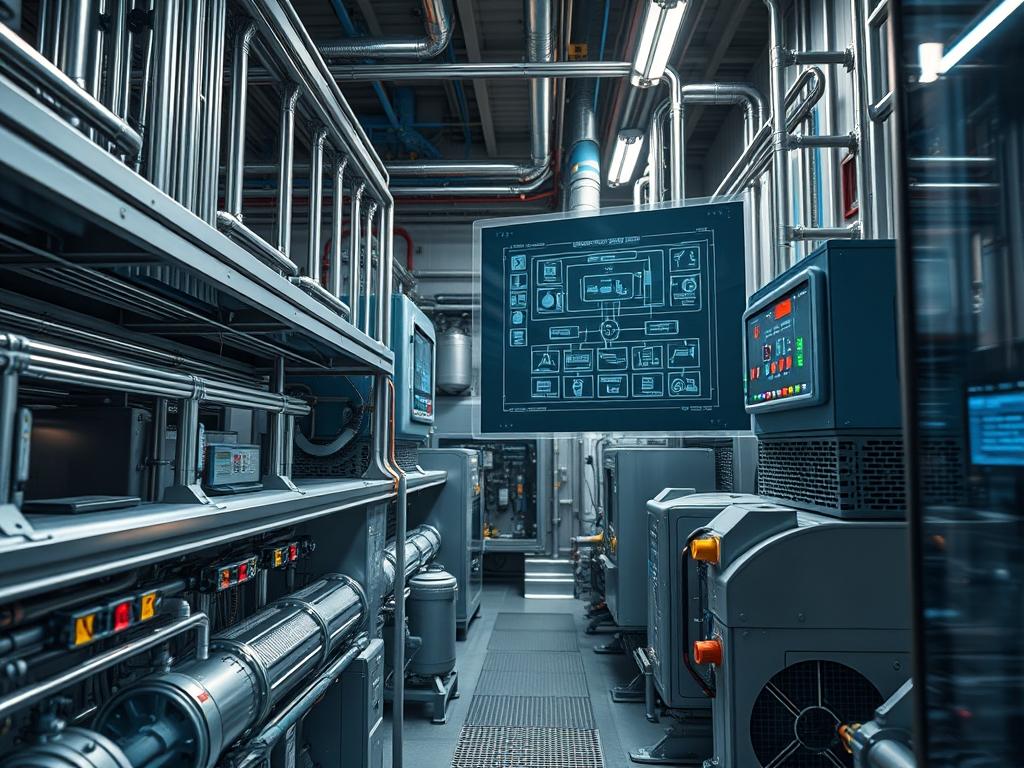
Designing a multi-stage Reverse Osmosis (RO) system requires a sophisticated understanding of hydraulic balancing and mass transfer kinetics. In the context of industrial water infrastructure; RO System Staging Design serves as the primary mechanism for maximizing volumetric recovery while minimizing the brine waste stream. This architecture is not merely a plumbing configuration; it is an integrated technical stack involving high-pressure fluid dynamics, real-time chemical sensing, and automated logic control. The core challenge involves the concentration of solutes. As pure water is extracted as Permeate, the remaining Brine becomes increasingly concentrated; raising the osmotic pressure requirement for subsequent stages. A successful staging design ensures that each Membrane Element operates within its specific flux and recovery limits to prevent irreversible fouling or mechanical compaction. By arranging Pressure Vessels in a series-parallel array, engineers can achieve recoveries of 75 percent to 90 percent; significantly reducing the environmental footprint and operational overhead associated with raw water acquisition and waste disposal.
Technical Specifications
| Requirement | Default Operating Range | Protocol/Standard | Impact Level (1-10) | Recommended Resources |
| :— | :— | :— | :— | :— |
| System Flux | 12 – 18 GFD | ASTM D4194 | 9 | High-Surface Area Membranes |
| Feed Pressure | 150 – 450 PSI | ASME BPVC Section X | 10 | Multi-Stage Centrifugal Pump |
| Control Logic | Modbus TCP/IP | IEEE 802.3 | 7 | Industrial PLC / logic-controller |
| Recovery Rate | 50% – 85% | NSF/ANSI 58 | 8 | VFD-driven High Pressure Pump |
| Power Supply | 460V / 3-Phase | NEC Article 430 | 6 | NEMA 4X Enclosure |
| Data Polling | 100ms Latency | TCP/UDP | 5 | Cat6 Shielded Cabling |
The Configuration Protocol
Environment Prerequisites:
Successful deployment of an RO System Staging Design requires a controlled environment with specific atmospheric and hydraulic tolerances. The raw water feed must meet Silt Density Index (SDI) requirements of less than 3.0 to prevent premature Membrane degradation. Electrical systems must adhere to NEC standards; specifically ensuring that all Variable Frequency Drives (VFDs) are phased correctly to prevent reverse impeller rotation. The control environment requires a SCADA or PLC interface running firmware compatible with Modbus or EtherNet/IP protocols. User permissions for the HMI (Human Machine Interface) should be tiered; providing “Technician” level access for setpoint adjustments and “Administrator” level access for internal PID loop tuning and safety interlock overrides.
Section A: Implementation Logic:
The engineering logic behind multi-stage design is centered on maintaining a constant Flux Rate across the entire system. In a single-stage system; the Feed water velocity drops as Permeate is removed; leading to stagnant zones and high Concentration Polarization at the tail-end membranes. Multi-stage design solves this by redirecting the Reject (concentrate) from the first stage into a smaller number of vessels in the second stage. This maintains high cross-flow velocity; which is an idempotent process in terms of physical membrane protection. High velocity effectively “scours” the membrane surface; reducing the payload of minerals that can precipitate. Mathematically; a 2:1 staging array (two vessels in stage one, one vessel in stage two) ensures that the Brine velocity in the second stage remains high enough to prevent scaling even as the salt concentration increases.
Step-By-Step Execution
1. Sensor Calibration and Signal Verification
Before introducing hydraulic load; use a fluke-multimeter to verify the 4-20mA loops for all Pressure Transducers and Flow Meters. Ensure the logic-controller accurately reflects zero-scale and full-scale values.
System Note: This step prevents signal-attenuation errors from triggering false “High Pressure” trips during the initial startup phase; ensuring the Kernel of the control logic receives clean data.
2. Low-Pressure Air Purge and Pre-Fill
Open the Permeate Dump Valve and initiate a low-pressure fill at less than 30 PSI using the Feed Pump. Monitor the Air Release Valves at the high points of the Pressure Vessels.
System Note: Removing air prevents hydraulic “water hammer” events that can cause Membrane cracking or O-ring displacement within the vessel’s internal Interconnectors.
3. VFD Ramp-Up and PID Activation
Engage the High Pressure Pump via the HMI. Use the logic-controller to ramp the frequency of the VFD at a rate of 5Hz per second. Target the design Feed Flow rather than a specific pressure.
System Note: Controlling by flow via a PID-Loop manages the throughput of the system dynamically; compensating for changes in water temperature which affect the water’s thermal-inertia and viscosity.
4. Stage-to-Stage Balancing
Adjust the Concentrate Control Valve to reach the target Recovery Rate for the RO System Staging Design. Measure the pressure drop (Delta-P) across Stage 1 and Stage 2 independently.
System Note: Excessive Delta-P in a single stage indicates Encapsulation of debris or mineral scaling within the membrane spacers; requiring an immediate adjustment to the anti-scalant dosing payload.
5. Permeate Quality Verification
Monitor the Conductivity Sensors until the Permeate quality stabilizes. Ensure the Rejection Rate exceeds 98.5 percent for standard brackish water membranes.
System Note: The latency in conductivity stabilization is typical; as the membranes must reach a state of osmotic equilibrium before the ion-rejection overhead is fully optimized.
Section B: Dependency Fault-Lines:
The primary failure point in RO System Staging Design is the “Brine Seal” bypass. If a brine seal is installed in the wrong orientation; the Feed water will bypass the membrane envelope entirely; leading to high Permeate conductivity and low system pressure. Another critical bottleneck is the Inter-stage Pressure Drop. If the plumbing between Stage 1 and Stage 2 is undersized; the resulting Overhead in energy consumption will lead to a Thermal-inertia buildup in the pump; causing a high-temp shutdown. Furthermore; any Packet-loss in the communication between the Flow Meter and the PLC can cause the pump to over-pressurize the vessels; leading to a catastrophic mechanical breach of the Pressure Vessel end-caps.
THE TROUBLESHOOTING MATRIX
Section C: Logs & Debugging:
When a system fault occurs; the first point of analysis should be the Alarms Log on the PLC. Look for the “High Differential Pressure” error string. If the log shows a sudden spike; inspect the Pre-filtration gauges for a ruptured Cartridge Filter. If the fault is gradual; review the Normalized Permeate Flow data. A 10 percent decrease in normalized flow indicates fouling or scaling.
For physical diagnostics; check the Reject stream for air bubbles; which suggests a leak on the suction side of the Feed Pump. Use the fluke-multimeter to check for signal-attenuation on the 24VDC power supply to the sensors; as unstable voltage can cause erratic Flow readings. If the HMI reports “Communication Lost”; verify the Cat6 integrity and check for Packet-loss at the Network Switch located in the control panel. Path-specific troubleshooting should follow the sequence: Raw Water Inlet > Chemical Injection > High Pressure Pump > Stage 1 Vessels > Stage 2 Vessels > Permeate Manifold.
OPTIMIZATION & HARDENING
Performance Tuning
To optimize Throughput and Thermal Efficiency; implement a “Warm-Water Shunt” if the feed water temperature drops below 15 degrees Celsius. Cold water increases viscosity; requiring higher pressure and more energy. Additionally; tuning the VFD carrier frequency can reduce harmonic distortion in the motor; lowering the heat overhead in the electrical cabinet. Ensure the logic-controller uses a lead-lag configuration if multiple pumps are present to balance run-time hours.
Security Hardening
Physical security is paramount for critical water infrastructure. Ensure all Manual Override switches are locked and require a physical key. From a digital perspective; the PLC should reside on a VLAN isolated from the corporate network to prevent unauthorized access to the Modbus registers. Implement Fail-safe physical logic: provide a mechanical high-pressure relief valve that operates independently of the Electronic Sensors to provide redundant protection against a software “hang” or update failure.
Scaling Logic
Maintaining efficiency under high load requires the ability to “Train” multiple RO units. In a multi-rack system; the Master Controller should distribute the Payload based on the specific Flux of each rack. As demand increases; the system should activate additional racks in an idempotent fashion; ensuring that starting the third rack does not cause a pressure drop that trips the first two. This requires a robust Buffer Tank level-logic to prevent frequent pump cycling; which would increase the mechanical wear on the Impellers.
THE ADMIN DESK
How do I handle a “High Permeate Conductivity” alarm?
Check the O-rings on the Interconnectors first. A cracked seal allows raw water to bypass the membrane; spiking conductivity. Alternatively; check the Anti-scalant Pump to ensure it is delivering the correct chemical Payload to prevent membrane scaling.
What is the maximum allowed pressure drop per stage?
Typically; the pressure drop should not exceed 10-15 PSI per membrane element or 50 PSI per pressure vessel. Excessive drop indicates mechanical fouling or high Throughput beyond design limits. Use a systemctl log check if using a Linux-based SCADA.
Why is my VFD displaying a “DC Bus Overvoltage” fault?
This usually occurs during rapid deceleration. Adjust the Deceleration Ramp in the VFD settings to be more gradual. This reduces the regenerative energy returned to the drive; preventing a shutdown during the power cycling of the RO System Staging Design.
How often should I normalize the system data?
Data normalization should occur daily. It compensates for variables like temperature and salinity; allowing you to see the “True” health of the membranes. Use Standardized Software or a specialized spreadsheet to calculate the Flux and Rejection rates accurately.
Can I run the system at 95 percent recovery?
Running at 95 percent is dangerous without specialized high-pressure hardware and advanced chemistry. It pushes the Solubility Limit of minerals; leading to instantaneous scaling. High recovery increases the Osmotic Pressure significantly; requiring an expensive Energy Recovery Device.