
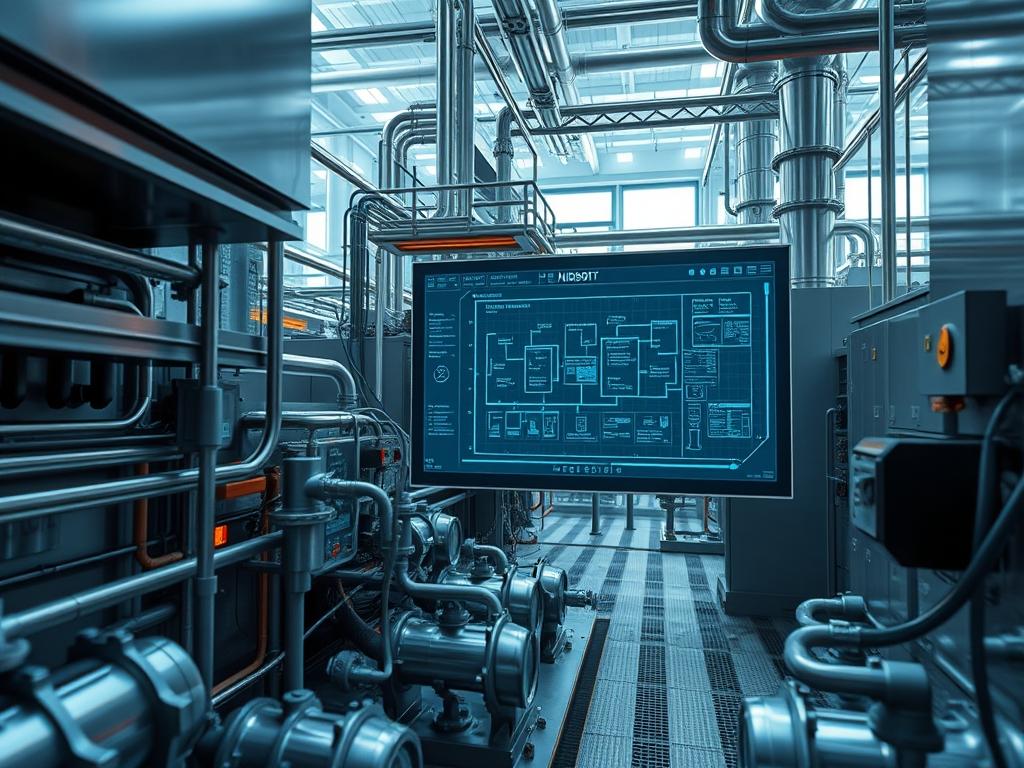
High Salinity RO Challenges represent the primary architectural bottleneck in modern desalination and industrial brine management systems. As feedwater concentrations exceed 35,000 parts per million of Total Dissolved Solids, the thermodynamic hurdles for effective separation scale non-linearly. The core difficulty lies in overcoming osmotic pressure while mitigating the accelerated degradation of mechanical components caused by chloride enrichment. Engineers must manage the trade-off between energy throughput and membrane longevity; a balance that requires precise control over pressure-driven flux and chemical scaling inhibitors. Within the technical stack, this infrastructure resides at the intersection of high-pressure fluid dynamics and automated control logic. Success in this domain necessitates a ruggedized approach to materials science and a high-concurrency SCADA architecture to handle real-time sensor data. Addressing these challenges is fundamental to achieving industrial water circularity and reducing the energy overhead associated with hypersaline fluid processing.
Technical Specifications
| Requirement | Operating Range | Protocol/Standard | Impact Level | Recommended Resources |
| :— | :— | :— | :— | :— |
| Operating Pressure | 55.0 to 85.0 bar | ASME B31.3 | 10 | API 674 PD Pump |
| TDS Monitoring | 0 to 120,000 ppm | ASTM D1125 | 9 | Inductive Conductivity |
| Flux Rate | 12 to 18 LMH | ISO 23446 | 7 | Polyamide Thin-Film |
| Control Latency | < 50 ms | Modbus/TCP | 8 | PLC with 8GB RAM |
| Materials Grade | 254 SMO / Titanium | ASTM A240 | 10 | Super Duplex Piping |
| Cooling Capacity | 15C to 35C Delta | ASHRAE | 6 | Shell-and-Tube Exchanger |
The Configuration Protocol
Environment Prerequisites:
Implementation requires a controlled industrial environment compliant with IEEE 802.3 for networking and NEC Class 1 Division 2 for electrical safety in proximity to corrosive saltwater. Software dependencies include a logic controller firmware version 4.5 or higher and a historian database capable of 100ms sampling rates. Personnel must possess Root-level administrative access to the SCADA gateway and physical clearance for high-pressure localized zones. All high-pressure fittings must be verified against ISO 9001 quality audits prior to system pressurization.
Section A: Implementation Logic:
The engineering design focuses on minimizing the specific energy consumption by employing isobaric Energy Recovery Devices (ERDs). The logic dictates that the high-pressure pump only provides the differential pressure required to overcome membrane resistance; the ERD handles the lift for the recycle stream. This architecture reduces the motor sizing requirement and dampens thermal-inertia within the fluid loop. By segregating the brine and permeate streams through high-rejection membranes, we maximize salt passage resistance. The system utilizes automated chemical dosing based on real-time Langelier Saturation Index (LSI) calculations to prevent idempotent scaling events on the membrane surface.
Step-By-Step Execution
1. Initialize Pre-Treatment Sensors
Verify the integrity of the Feed_Water_Sensor_Array by executing a calibration sweep using sensor-tool –calibrate /dev/ttyS0.
System Note: This action ensures that the input data for the PID loop is accurate; preventing premature pump acceleration or incorrect chemical dosing ratios.
2. Configure High-Pressure Variable Frequency Drive
Access the drive controller via telnet 192.168.1.50 and set the maximum frequency limit to 60Hz. Apply the command vfd_set –ramp-up 120s to establish a soft-start protocol.
System Note: Slow ramp-up intervals prevent hydraulic shock and water hammer; protecting the structural integrity of the Membrane_Pressure_Vessel.
3. Deploy Energy Recovery Device Logic
Map the isobaric exchanger state-matrix within the PLC using the Modbus_Write_Reg function at address 40001. Ensure the bypass valves are in the “closed” position for initial priming.
System Note: This synchronizes the pressure exchange between the high-pressure brine and the incoming feed; reducing the total power payload on the electrical grid.
4. Set Membrane Permeate Backpressure
Manually adjust the Back_Pressure_Regulator_Valve while monitoring the Permeate_Flux_Transmitter. Use a fluke-multimeter to verify the 4-20mA loop signaling the valve position.
System Note: Maintaining a consistent backpressure prevents membrane compaction and ensures uniform flux across the entire leaf surface.
5. Establish SCADA Encryption and Logging
Enable TLS_1.3 on the SCADA_Gateway and point the log output to /var/log/water_proc/high_salinity_main.log using systemctl restart rsyslog.
System Note: This secures the control telemetry from external injection attacks and provides a persistent audit trail for performance analysis.
Section B: Dependency Fault-Lines:
The primary mechanical bottleneck is the accumulation of biological matter on the membrane surface; commonly known as biofouling. This increases the differential pressure and forces the pump to consume more energy to maintain throughput. Software-side conflicts often arise when the PLC polling rate exceeds the signal-attenuation limits of long-distance RS-485 cables; leading to packet-loss in the conductivity feedback loop. Hardware incompatibilities between non-metallic piping and high-vibration pump mounts can lead to fatigue-induced leaks.
THE TROUBLESHOOTING MATRIX
Section C: Logs & Debugging:
Monitor the system for error code ERR_HIGH_DP_04; which indicates a delta pressure across the membrane bank exceeding 2.5 bar. When this occurs; check the log files at /opt/hro/logs/diagnostics.json for specific flux decay patterns. If the sensor readout shows a plateauing trend; inspect the Antiscalant_Dosing_Pump for mechanical failure or empty reservoir flags.
Visual cues from the equipment are critical: a vibrating High_Pressure_Line usually signals pump cavitation or air entrainment in the suction manifold. Use the command tail -f /var/log/hro_system.log to watch real-time interrupt requests from the flow meters. If signal-attenuation is suspected; use an oscilloscope to check the square-wave integrity of the Flow_Pulse_Generator. For hardware-level faults; refer to the LED diagnostic array on the PLC_Input_Module; a flashing red light on channel 3 typically denotes an open-circuit in the thermal-couple line.
OPTIMIZATION & HARDENING
– Performance Tuning: Adjust the PLC logic to implement a “Feed-Forward” control scheme. By measuring the feedwater conductivity before it reaches the membrane; the system can pre-emptively adjust the VFD_Speed to maintain constant permeate quality. This reduces latency in the quality-control loop and increases overall system throughput during salinity spikes.
– Security Hardening: Implement strict iptables rules on the communication gateway. Only allow outbound traffic on Port_502 for Modbus and Port_443 for encrypted web monitoring. Physically lock the local HMI (Human Machine Interface) screen with a hardware-based security key to prevent unauthorized setpoint manipulation. Ensure all chmod 600 permissions are set on the configuration files located in /etc/hro_control/.
– Scaling Logic: To expand capacity; integrate additional Pressure_Vessel_Racks in a parallel configuration. The SCADA system should use a master-slave architecture for the High-Pressure pumps to distribute the load evenly. This approach ensures that the system maintains thermal-efficiency and prevents any single point of failure from causing a total plant shutdown during high-demand cycles.
THE ADMIN DESK
How do I clear the “Membrane Fouling” alarm?
First; initiate a CIP_Sequence (Clean-In-Place) using the automated chemical injection routine. Once the Differential_Pressure returns to the baseline; use the SCADA command reset_alarm –id 405 to clear the fault from the active queue.
What is the ideal SDI for high-salinity feed?
The Silt Density Index (SDI) should remain below 3.0 to prevent rapid particulate accumulation. Higher values require an immediate audit of the Multimedia_Filter and the integrity of the 0.5_Micron_Cartridge_Filters located upstream of the high-pressure pump.
Why is my permeate conductivity rising suddenly?
This usually indicates an “O-Ring Bypass” or a “Membrane-Seal Failure”. Use the Probe-Mapping technique to isolate the specific Pressure_Vessel rack showing the spike and inspect the internal connectors for chemical degradation or mechanical displacement.
Can I run the system at 100% recovery?
No; attempting 100% recovery in high-salinity applications leads to immediate mineral precipitation and membrane destruction. Most hypersaline RO systems are limited to 35-50% recovery to ensure that the concentrate stream remains below the saturation point of scale-forming salts.