
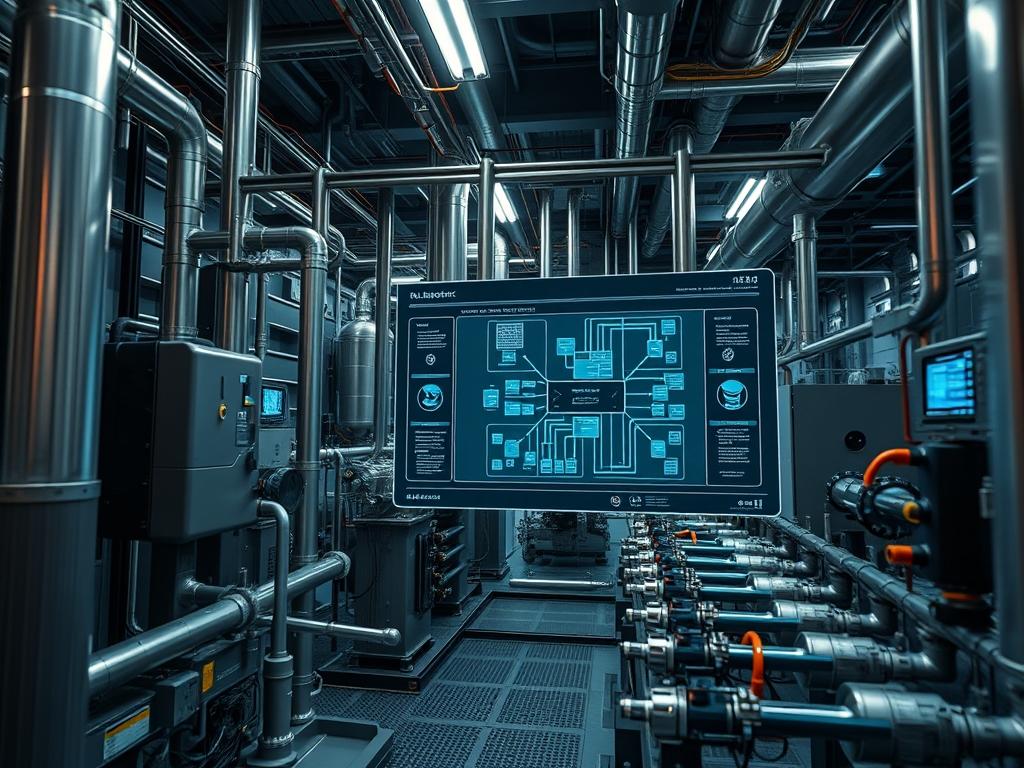
Dissolved gas removal represents a critical phase in high-purity water treatment, bridging the gap between standard Reverse Osmosis (RO) and Electrodeionization (EDI) or mixed-bed polishing. The primary objective of an RO Degasification Unit Setup is the elimination of Oxygen (O2) and Carbon Dioxide (CO2) to prevent downstream equipment corrosion and to optimize the ionic load on polishing resins. In an industrial technical stack, this unit functions as a physical-layer process controlled by a SCADA or PLC interface, managing the partial pressure differential across a hydrophobic membrane. This setup addresses the “Conductivity Floor” problem; while RO membranes effectively reject ionic species, dissolved gases pass through the permeate side, often resulting in elevated conductivity that mimics mineral breakthrough. By applying Henry’s Law through a combination of vacuum pressure and sweep gas mechanisms, the degasification unit ensures the permeate attains the required chemical stability for high-pressure boilers, semiconductor fabrication, or pharmaceutical synthesis.
TECHNICAL SPECIFICATIONS
| Requirement | Default Port / Operating Range | Protocol / Standard | Impact Level (1-10) | Recommended Resources |
| :— | :— | :— | :— | :— |
| Feedwater Pressure | 2.0 to 4.5 bar | ASME B31.3 | 8 | Schedule 80 PVC / SS316 |
| Vacuum Setpoint | 50 to 100 mbar | ISO 21360-1 | 9 | Liquid Ring Vacuum Pump |
| Control Interface | Modbus TCP / Port 502 | IEEE 802.3 | 6 | 4GB RAM / Quad-core PLC |
| Sweep Gas Flow | 0.5 to 2.0 m3/hr | CGA G-10.1 (Nitrogen) | 7 | Ultra-High Purity N2 |
| Specific Flux | 15 – 25 LMH | ASTM D4194 | 5 | Hydrophobic PP Membrane |
THE CONFIGURATION PROTOCOL
Environment Prerequisites:
Before initiating the RO Degasification Unit Setup, verify that the RO permeate conductivity is within the design envelope of 5 to 50 micro-Siemens. Physical infrastructure requires a dedicated NEMA-4X enclosure for electronic controls to mitigate moisture ingress. Software dependencies include a PLC firmware version compatible with IEC 61131-3 standards for logic execution. Ensure all user permissions for the SCADA nodes are elevated to Grade-A Administrative levels to permit the modification of PID loop constants. Mandatory hardware includes a Fluke-789 ProcessMeter for loop calibration and high-precision PT100 RTD sensors for monitoring water temperature, as thermal-inertia directly influences gas solubility constants.
Section A: Implementation Logic:
The engineering design relies on the principle of gas diffusion across a non-porous but gas-permeable membrane. The setup utilizes hydrophobic hollow fiber technology to create a barrier where liquid cannot pass, but gases migrate toward the lower partial pressure zone. By maintaining a vacuum on the shell side of the membrane contactor, the system forces dissolved CO2 and O2 out of the aqueous phase. This process is inherently idempotent; repeatedly applying the same vacuum level to a stable feed will result in the same effluent gas concentration, assuming environmental variables remain constant. The efficiency of the “Payload” (removed gas volume) is a function of the surface area available and the throughput velocity of the water, which dictates the residence time for diffusion to occur.
Step-By-Step Execution
1. Membrane Contactor Housing Assembly
Secure the Degasifier-Membrane-Module vertically to the skid frame using vibration-dampening mounts. Connect the RO permeate line to the Liquid-Inlet-Port and ensure the Liquid-Outlet-Port lead to the EDI or storage tank.
System Note: Correct physical orientation prevents air-pocket encapsulation within the fiber bundles; air pockets create “dead zones” that increase signal-attenuation in flow sensors and reduce the effective surface area for gas exchange.
2. Vacuum System Integration
Install a Liquid-Ring-Vacuum-Pump on the shell-side gas outlet of the contactor. Use reinforced Vacuum-Rated-Tubing to prevent collapse under negative pressure. Execute the command systemctl start vac-pump-controller.service on the logic-unit to initialize the vacuum sequence.
System Note: This action lowers the ambient pressure within the contactor shell, shifting the chemical equilibrium of the system and forcing the dissolved gases to exit the liquid phase into the vacuum stream.
3. Sweep Gas Calibration
Connect a Nitrogen (N2) supply to the Gas-Inlet-Port via a mass flow controller. Set the flow rate to the calculated stoichiometric requirement based on the current CO2 payload. Use the command set-sweep-gas –flow 1.5 –unit m3h in the configuration console.
System Note: Introducing a sweep gas reduces the partial pressure of the target gas (O2/CO2) on the gas side to near-zero; this maximizes the concentration gradient and improves the throughput of gas removal without increasing the vacuum overhead.
4. Sensor Loop Normalization
Calibrate the Dissolved-Oxygen-Sensor and the pH-Probe using standard buffer solutions. Map these inputs to the PLC via Modbus-Register-40001 and 40002. Run an automated calibration cycle to ensure that the sensor feedback loop is functional and the PID response is tuned.
System Note: Proper normalization ensures that the PLC can react to spikes in feed gas concentration; this prevents the latency associated with manual adjustment and maintains a steady-state effluent quality.
5. Final Hydraulic Testing
Slowly open the Inlet-Isolation-Valve to graduate the flow. Monitor the Differential-Pressure-Transducer (dP) across the liquid side of the membrane. Ensure the dP does not exceed 1.5 bar to avoid fiber rupture.
System Note: High differential pressure indicates potential scaling or bio-fouling within the membrane pores; monitoring this variable is essential for maintaining the long-term hydraulic integrity of the RO Degasification Unit Setup.
Section B: Dependency Fault-Lines:
The primary mechanical bottleneck in this setup is the “Wetting-Out” of the membrane. If the liquid-side pressure exceeds the breakthrough pressure of the hydrophobic material, water will enter the gas capillaries, causing an immediate drop in gas removal efficiency and a massive increase in vacuum pump load. Another significant fault-line is the thermal-inertia of the feedwater. Cold water (under 10 degrees Celsius) holds dissolved gases more tenaciously; failing to adjust vacuum levels for seasonal temperature shifts will result in sub-optimal degasification. Finally, library conflicts in the SCADA HMI can lead to “ghost” alarms where the vacuum pressure appears low due to a packet-loss issue in the communication bus rather than a physical leak.
THE TROUBLESHOOTING MATRIX
Section C: Logs & Debugging:
When the system performance degrades, the first point of audit should be the hardware log located at /var/log/water_process/degas_unit.log. Look for error strings such as “VAC_PUMP_VACUUM_LOW” or “N2_SWEEP_LOW_FLOW”.
1. Error: High Effluent Conductivity. Check the pH sensor readout. If the pH is low (under 6.0), the RO Degasification Unit Setup is failing to remove CO2. Verify the vacuum gauge at the contactor shell. If the gauge reads above 150 mbar, inspect the Vacuum-Relief-Valve for leaks.
2. Error: Dissolved Oxygen Spike. This usually indicates a leak in the vacuum manifold or a failure in the Nitrogen sweep gas supply. Check the Oxygen-Concentration-Log for sudden steps in the data, which suggest physical seal failure rather than membrane fouling.
3. Error: High Differential Pressure. Inspect the Inlet-Pre-Filter. If the filter is clean, the membrane may be scales. Use a logic-controller to execute a flushing cycle using a non-surfactant cleaning agent.
4. Error: SCADA Timeout. If the HMI fails to update, check the RJ45-Connection and looks for signal-attenuation near high-voltage motor cables. Ensure the Shielded-Twisted-Pair cable is properly grounded to prevent EMI.
OPTIMIZATION & HARDENING
Performance Tuning:
To maximize the concurrency of gas removal with high fluid throughput, implement a dual-stage vacuum approach. Set the first membrane bank to “Rough Vacuum” (200 mbar) and the second bank to “Deep Vacuum” (50 mbar). This staggered configuration reduces the energy overhead of the vacuum pumps while ensuring the final payload removal meets parts-per-billion (ppb) requirements. Use the optimization-script.sh –mode high-recovery to adjust the sweep gas ratio automatically based on real-time ORP and pH sensor data.
Security Hardening:
Physical security requires the locking of all manual bypass valves to prevent unauthorized hydraulic redirection. At the network level, isolate the PLC controlling the RO Degasification Unit Setup onto a separate VLAN with no external internet access. Apply iptables rules to restrict Port 502 access to the known MAC address of the SCADA workstation. Disable all unused services on the controller, such as FTP or Telnet, to reduce the attack surface.
Scaling Logic:
The system is designed for modular expansion. To scale the capacity, add membrane contactors in a “Parallel-Train” configuration. This allows the system to handle higher volume without increasing the individual membrane pressure drop. When adding modules, update the PLC logic to include the new Flow-Transmitter inputs, ensuring that the vacuum load is balanced across all active “Shell-Side” ports.
THE ADMIN DESK
Q: How do I know if the hydrophobic membrane is “Wetted-Out”?
Check the gas discharge line from the vacuum pump. If liquid water is present in the separator tank, the membrane fibers have been compromised by high pressure or surfactants. Immediate replacement or specialized drying is required.
Q: Can I use compressed air instead of Nitrogen as a sweep gas?
Compressed air can be used to remove CO2, but it will introduce Oxygen into the water. For boiler-feed or ultrapure applications where O2 removal is mandatory, only high-purity Nitrogen should be utilized as a sweep.
Q: What is the impact of RO permeate pH on degasification?
Degasifiers only remove CO2 in its gaseous form (CO2 gas). If the pH is high (above 8.2), the CO2 exists primarily as bicarbonate ions, which cannot cross the membrane. Acidification may be required to shift the equilibrium.
Q: Why is my vacuum pump running hot?
Check for restricted airflow in the shell-side gas ports or a clogged Vacuum-Inlet-Strainer. High “Overhead” in the motor suggests the pump is fighting a blockage or operating too far from its designed performance curve.
Q: How often should I calibrate the dissolved oxygen sensors?
Sensors should be calibrated bi-weekly using a “Zero-Oxygen” solution. Idempotent performance in your sensing loop is the only way to ensure the degasification unit is meeting the stringent ppb requirements for industrial feed.